Wednesday, December 30, 2015

Here Rest the Victims of the Brooklyn Theater Fire


Burial of Unclaimed Dead in Greenwood Cemetery, Harper's Weekly, December 30, 1876

 
On December 30, 1876, the last victim of the Brooklyn Theater Fire was laid to rest in the Green-Wood Cemetery. That day, Harper's Weekly journal printed an engraving made from a sketch of Edwin Austin Abbey (above). This was the only known images of the scene at the cemetery on December 9, when the mass burial of the unidentified victims of the fire took place. As I wrote in my previous blog post, the exact number of the victims was different from source to source. To date, I have located all three death certificates that were issued by Coroner Simms pertaining to those victims whose bodies were not identified; their number is 102.

The circular mass grave, as the image above shows, is located at the corner of Battle and Bay View Avenues in Green-Wood Cemetery. Properly numbered lots 22427-22432 in Section N, the gravesite was purchased by the City of Brooklyn. Four years after the burial, after many political debates about the cost and design, a monument commemorating the tragic event was erected at the center of the circular lots.


The Daily Graphic, June 23, 1881, page 850


At the time of installation of the monument, the lots were also enclosed with iron railing connected by granite posts. Sometimes in 1960s, as the cemetery's records indicate, some of the railings were stolen in an act of vandalism prompting the removal of the remaining enclosures. Though the surrounding area has changed drastically, the monument still stands tall


December 2015


The grey obelisk monument was inscribed with history of the fire on its four panels, one of which read: the remains of one hundred and three were buried in this plot with civic and military honors on Saturday, December 9, 1876. Despite what is inscribed on the stone, the actual number of unrecognized bodies is 102, as the official records (below) show. Moreover, the following four known victims were also laid to rest in the mass grave:
  • Robert Boyle (Certificate of Death 11433)
  • William Frank (Certificate of Death 11287)
  • Sidney Lewis or Luers (same as Sydney Evans, Certificate of Death 11293)
  • Michael Cassidy (N/A)


As the New Year approaches, I am making my resolutions, one of which is to complete my goal of establishing the online memorial for the 140th anniversary of the fire. I am hoping to write about individual victims in my next posts, in which I will address the discrepancies in the above listed names and death certificates. In the meantime, here are copies of three death certificates as they were issued for the "unknown" victims.


Certificate of Death 11397 issued for one unknown who died "by Burns on Dec 5, '76" at Brooklyn Theatre
Certificate of Death 11408 issued for "100 bodies for burial" of "unknown from morgue and market" 

Certificate of Death 11653 issued for one remains "found at the Brooklyn Theatre Dec 12th, 1876"


Saturday, December 5, 2015

The Day When Brooklyn Burned


This is a first of many posts in creating a permanent online memorial commemorating the lives of the victims of Brooklyn Theater Fire. The story is almost one hundred forty years old, and I learned about it in 2008 while still a student at the Brooklyn College. It is a tragic tale that has not been told fully. Ever since my graduation in 2009, it has been my goal to create a memorial for all those who lose their lives that fateful night on December 5, 1876.

~*~

The Theater and the Play
Talks around the town about Mrs. Conway's new theater in Brooklyn began in early months of 1871. Sarah Crocker Conway (1834-1875) and her husband, Frederick B. Conway (1819-1874), were successful managers of the Park Theater on Adams Street since 1864. They took over from the original proprietor, Mr. Gabriel Harrison, who had financial difficulties in running the theater since its doors opened a year prior. The Conways were successful enough that they required a new playground for their artistic abilities, and so the Brooklyn Theater was built on the corner of Washington and Johnson Streets, located diagonally from the Park Theater on Adams and Fulton Streets. 


Portion of Plate F in Detailed Estate and Old FarmLine Atlas of The City of Brooklyn as published by G.M. Hopkins and Co. in 1880


"Opening of the New House of Amusement" was announced in the Brooklyn Daily Eagle. On October 2, 1871, "precisely at the hour of seven o'clock the doors were thrown open" and" at "eight o'clock the curtain went up and discovered the full strength of the company standing upon the stage. 'The Star Spangled Banner' was sun...[and at] its close, Mr. and Mrs. Conway entered upon the stage, and, being recognized, they were accorded such a reception as but few public people receive in their lifetime."

The opening play was Money, a comedy by an English playwright Lord Lytton. "Of course, the house was crowded," reported the Eagle, "and a greater number stood outside and watched the fortunate possessors of seats go in." Such crowds at the Brooklyn Theater were hard earned by the determination of its proprietors, for theirs was a competition with many other "amusement houses" not only in Brooklyn but also in New York. Actually, the whole venture in the Brooklyn Theater, as was reported in Mrs. Conway's obituary "proved a disastrous investment. The class of audiences to which they now appealed again were slow to believe that as good performances could be given in Brooklyn as in New York."

The fight to carve a niche in the theater world of Brooklyn proved too much for Mr. Conway; he withdrew himself from work as his health began to deteriorate by 1873. On September 6, 1874, Frederick Bartlett Conway died in Massachusetts and his body was brought to Brooklyn to be laid to rest in the Green-Wood Cemetery (Lot 16823, Section 167). 


Brooklyn Theater is the second building to the left of post office.

Three months later, the Union Theater in New York announced production of a new play, The Two Orphans. The play was an adaptation by Naphtali Hart Jackson of New York from the French Les Deux Orphelines by Adolph D'Ennery and Eugene Cormon. The Union Theater was owned by Sheridan Shook and managed by Albert Marshman Palmer, the two men who commissioned Hart Jackson (who legally changed his name in 1876) for the English version of the play.

On April 12, 1876, Mrs. Conway, having obtained permission from Messrs. Shook and Palmer, staged the production of The Two Orphans in Brooklyn Theater for the first time. On that day, Miss Lillian Conway, daughter of the proprietors, made her stage debut in the role of Louise, one of the orphans. "The play was played, and success followed. Mrs. Conway at last saw her dreams realized. She started to reach this goal. She reached it and died" on April 28, 1876, reported The Eagle. Children of the Conways became the new lessees, but within a year of their management they had to relinquish their interests in Brooklyn Theater in favor of Messrs. Shook and Palmer.

On December 5, 1876, the evening issue of the Brooklyn Daily Eagle published a review of The Two Orphans from previous night: on a scale as to human and mechanical interpretation, which certainly made a near approach to the common idea of perfection. The audience, although in point of numbers it was scarcely on a par with the claims of the occasion, was visibly moved during the progress of the play and must have left the theatre with an impression of the performance such as in itself ought to prove no bad advertisement of its excellence. The applause was frequent, hearty and spontaneous, and in response to it the curtain had to be raised after nearly every one of the seven tableaux, by which the action of the piece is articulated...The whole representation, therefore, was one which exacts the acknowledgement that little can be said of it except in the way of praise.

After a few hours the review was published, the doors of the Brooklyn Theater were opened once again for the audience. That night, the play took a different turn by the time it ended. At about 11:15 pm, just before the last act, the house curtains caught fire. In less than half hour, the entirety of the theater building was engulfed in flames.

Cover of the December 23, 1876 issue of the Harper's Weekly


The Number of Victims

Of the primary sources of information, the newspapers are the most common, but they are secondary in accuracy compared to the official records. These included reports given by the coroner of the city of Brooklyn, Henry C. Simms, the fire marshall, Patrick Keady, and the Executive Committee of the Brooklyn Theater Fire Relief Association report. My goal is to explore these sources, which deal primarily with the victims. The most important of the above mentioned is the coroner's report.

In the panic that ensued immediately following the fire, local newspapers published updated lists daily; sometimes twice a day, as more people searched for their loved ones. The reporters had two sources of information, the place of the tragedy and the families of the victims. The list was both of the actual dead found at the theater and the supposed victims of individuals who were reported missing by their families.

The Daily Argus printed a booklet titled The Holocaust  at the Brooklyn Theatre with an alphabetical list of the victims. The paper claimed that it was "the only authentic roll of the missing and recognized dead" being compiled "from official sources" with the "names of the recognized bodies...indicated by an asterisk (*)." When all the names are tallied, there are 350 total, including 138 unrecognized names and 212 identified bodies. These figures differ from other published reports.

The Brooklyn Daily Eagle published extensive reports of the fire giving detailed descriptions of the events leading up to it. For example, page four of the December 6, 1876 issue was exclusively devoted to the matters related to "The Calamity" and included the first list of the missing and injured individuals. The first list of the "Known to be Dead" included a dozen names: At this writing thirty bodies have been taken out, but the pile is still four to five feet deep on the floor of the cellar under the vestibule.

The Eagle, December 7, 1876 issue, page 2
The Eagle, December 7, 1876 issue, page 4


As excavations of the rubble continued, the morgue was near capacity, prompting the city to establish makeshift morgues at nearby markets and theaters. By day two, The Eagle ran conflicting headlines: "Two Hundred and Eighty Dead" on page two and "Two Hundred and Ninety Dead" on page four.

On December 8, day three after the fire, The Eagle reported that "THE HOLOCAUST" consumed the lives of two hundred and ninety three individuals. The last list of the victims reported by the Daily Eagle was in the December 9 issue, on the same day when the burial of the unrecognized bodies took place in a mass grave in the Green-Wood Cemetery. Of the reported names, the list contained 163 names of individuals for whom burial permits were issued by the coroner. There were also 83 names of "persons known or believed to have perished in the flames whose bodies have not been identified". Some names however, appear on the list of those individuals who were given burial permits by the coroner.

Fire Marshal Keady lists 284 victims of the fire that included 102 "unknown bodies". This list is identical in number as reported by the coroner. Henry C. Simms issued 186 certificates of deaths, of those 3 were for unidentified victims; one for "100 bodies for burial" and two certificates each for one unknown body, thus a total of 102 were unrecognized. Burial permits were issued for 285 individuals. One victim of the fire was inadvertently issued two copies of death certificate, bringing the total number to 284.


The above link shows a list of victims organized by the death certificate numbers. It is a pdf file that can be downloaded and searched. It is important to note that there are gaps in the sequence of the certificates, i.e. between 11408 and 11424, whose records show cause of death other than fire at the Brooklyn Theater. Also, the last two individuals on the list, William Dench and John E. Cumberson, who were rescued, died a few days from the injuries. Regarding the records of the unknown victims, the above list does not include the third certificate which was issued at the end of December for someone who was laid to rest in Green-Wood on December 30, 1876.

And last, but not least, on one side of the granite obelisk that marks the site of the burial of the unknown victims in the Green-Wood Cemetery, the inscription reads: the remains of one hundred and three were buried in this plot with civic and military honors, on Saturday December 9, 1876. As the official records indicate, there were only 102 unknown victims, which is also confirmed by the records of the cemetery. Moreover, remains of four known victims were also laid to rest in the mass grave with the unknowns as their burials were paid for by the City of Brooklyn. Therefore, there are a total of 106 victims buried "under the obelisk" in Lots 22427-22432 in the Green-Wood Cemetery.

The Goal
My goal is to establish an online memorial for each of the known victims of the Brooklyn Theater Fire, whose total number is 182 individuals. The death certificates indicate places of death, which I will visit as part of the project. With the exception of eight who found their resting places outside of the state, all of the victims were buried in various cemeteries in New York City; the Catholic Cemeteries being the resting place of majority of the victims. I visited several unmarked graves, which I hope to remedy. But first things first first. This online memorial will list the full name of each victim along with corresponding records such as birth and marriage certificates, census and military reports, photographs where available and biographical sketches of each individual. Tonight marks the 139th anniversary of the fire. With my goals before me, I press on. Check back for the next installment.

Sunday, October 11, 2015

The Last Homestead of Modern Bensonhurst

As I write this post, a new building is seeing its final stages of completion in my neighborhood. It is a branch of the Bank of America on the corner of 66th Street, the latest addition to a chain of banks* on the 18th Avenue. One hundred years ago, the space that is occupied by the newly risen bank was the backyard of the Van Brunt-Robert homestead. The name indicates the first and last owners of the house throughout its almost 200 years of existence. The following is a history of the house and its owners, from first architects to the last residents; this isn't the most concise but it does contain almost everything I found on the subject and its occupants.


The Dutch Colonists

Rutger Joesten Van Brunt** (sometimes spelled Rutgert Joosten) emigrated from Netherlands in 1653. He was one of the first nineteen settlers of New Utrecht in 1657; in the same year, Rutger married Tryntje Claes, the widow of Stoffel Hermenson (Harmensen). Together, the Van Brunts built a house close to the town center, which was still standing in 1928 at 1752 84th Street address when it was demolished. The youngest son of Rutger and Tryntje was Joost Rutgersz Van Brunt, who on 16 April 1687 married Aeltie Van Voorhees. The venerable Teunis G. Bergen, author of the Genealogy of the Van Brunt Family, 1653-1867, wrote of Joost Rutgersz: On the division of his father's lands, Aug. 8, 1717, he obtained considerable real estate, and procured other tracts by purchase, becoming a large landholder.


Rutger Joosten Van Brunt House as it was sketched in Reminiscences of Old New Utrecht and Gowanus 
published by Charlotte Rebecca Bangs in 1912.

One of those tracts of land was a farmland on which Joost Rutgersz built a house that is the subject of this blog post. He modeled it after the one built by his parents in 1658. Charles Andrew Ditmas, author of the Historic Homesteads of Kings County and the only historian who mentioned its existence in his writings, called it the Van Brunt-Robarts Homestead. Ditmas wrote: Compared with the Colonel Jeromus Lott House erected previous to the Revolution, and to other landmarks of the pre-Revolution period, it was erected in the first part of the 18th century, as after 1750 the houses were given a higher foundation.

Joost Rutgersz Van Brunt and Aeltie Van Voorhees had one son, Rutgert, who was known by his nickname "Ryke Bood" (rich brother). As indicated by his sobriquet, Rutgert's fortunes included even more properties than that of his father, who died in 1746. He married Jannetje Van Dyck of New Utrecht and together they had five children, one son and four daughters. Rutger's son died before him, so upon his own demise in 1758 all his properties went to his daughters. The land on which the homestead was built was allotted to the second daughter, Maria, upon the division of the estate of Rutgert Van Brunt on 23 September 1762. By then, Maria, having married Joris Lott in 1737, was already a widow, for he had died a month prior on 26 August 1762. The Lotts had two children, a son, John who died before his father, and daughter, Jannetje.


The Van Brunt-Robarts Homestead photo-gravure from
Historic Homesteads of Kings County by Charles A. Ditmas, 1909

The British are coming!
Jannetje Lott was born on 14 January 1745 and on 24 September 1763 married a neighbor, Judge Nicholas Cowenhoven. Maria Lott, so tells us Bergen, died "a short time before the war of the revolution" in 1776, at which time "the farm on the road from the village of New Utrecht, to Flatbush...and about 40 acres of woodland" were inherited by her daughter Jannetje. This made a considerable addition to what Judge Cowenhoven already owned in the southeast of New Utrecht bordering Gravesend, a large tract of land that was to become the Bensonhurst by the Sea in 1880s.

Charlotte Rebecca Bangs, who published the Reminiscences of Old New Utrecht and Gowanus in 1912, wrote of the war period: While New Utrecht bears the distinction of being chosen by the British for their landing on American ground August 1776, there were no desperate battle scenes close to the several villages comprising the township. Echoes of the British were, of course, on every side but no fierce fights occurred. The English confiscated and ruined much during their occupancy of the farmhouses and buildings in every section thereabouts. 

The Rutger Joesten Van Brunt house, built in 1658, was occupied by the British soon upon their landing on the shores of Long Island. This is not an account of the Revolutionary War, but it must be noted here that the British marched toward the American troops using the two main routes. The first was the Kings Highway, portions of which still extant today under the same name. The second was the Road to Flatbush, current 18th Avenue, through which marched the troops under Major-General James Grant. Bangs noted in her book that the Van Brunt family members "were represented on the American side," which means one possible reason the Van Brunt-Robert homestead was spared the confiscation or ruin is because it stood away from the town center; the British marched by the house and had more pressing matters to attend to than harassment of the residents of the farmstead.


Portion of the 1867 map of Kings County showing the Plan of the Battle of Brooklyn as drawn by Doctor Samuel Edward Stiles.
The map indicates properties of Maria Lott as devised to her daughter, Jannetje Cowenhoven, prior to the war.
 

However, it is also very likely that the Van Brunt-Robert homestead was left intact because of the position of its then the owner, Judge Cowenhoven, who prior to the landing of the British had attained the rank of Colonel of the Kings County militia. On August 27, 1776, a meeting of The Committee of Safety was established and one of the outcomes of which was, based on the "reason to suspect that Nicholas Covenhoven, Esq., has given intelligence to the enemy of the Resolutions of this Convention" "to apprehend the said Nicholas Covenhoven" and present before the committee for examination. The next day, Colonel Covenhoven, examined by the New York Convention, reported that: On the day that the enemy landed, as he was returning from the lines, he was taken by a party of the enemy; they treated him roughly, took from him his sword and cockade, and carried him to Head-Quarters; was politely received by General Howe, who asked him if he would stay home and send his produce, which he promised to do.

After the war Colonel Covenhoven became the Chief Judge of the Kings County Court of Common Pleas, which would have been impossible had he been found guilty of treason. Rather, it is likely that due to his meeting with General Howe on the first day of landing, Colonel Covenhoven had a rapport with the general which allowed the colonel to act on behalf of the American prisoners with the British Commissary. Thus, sparing the confiscation of his property, including the Van Brunt-Robart homestead. 

Jannetje Lott and Judge Cowenhoven had two sons, John N. and George, but the elder was the only one who had issues. The judge died on 7 March 1793, at which time his properties in New Utrecht were left to his son John Nicholas Cowenhoven, who was born on 17 March 1769. In 1802, he married Susan Martense of Flatbush, who bore him two daughters: Maria and Jane.  He died on 3 November 1806, and all his properties went to his daughters, who, according to Ditmas: divided the land of their late father...on August 31, 1826. 

Maria Cowenhoven who married Egbert Benson in 1820 inherited her grandfather's, Judge Cowenhoven's, farmland that would become the original Bensonhurst (current neighborhood of Bath Beach). And her sister, Jane Cowenhoven, inherited the Van Brunt farmstead of her grandmother, Jannetje, which is currently in the modern Bensonhurst. One year after her inheritance, on 27 June 1827, Jane married Daniel Robert (sometimes spelled Roberts, or as Charles A. Ditmas would have it Robarts).

Thus, we have a house that was built by Joost Rutgersz Van Brunt sometimes between 1717 and 1746†, which passed to his son, Rutgert "Ryke Bood" Van Brunt. In 1762, it was occupied by Rutgert's daughter, Mrs. Maria Lott, and then by her daughter, Mrs. Jannetje Cowenhoven sometimes before the revolutionary war. Afterward, in 1826, the owner became Jannetje's granddaughter, Mrs. Jane Robert.


Portion of the 1852 map of Kings and Queens Counties published by M. Dripps.
Circled are the Egbert Benson property that would become the largest portion of
the Bensonhurst by the Sea, and the two properties owned by Daniel Robert.


The Last Residents

The longest residents of the house were its last owners, the Robert family. Jane Cowenhoven was born on 1 February 1805 in Flatbush, Kings County, and Daniel Robert on 15 November 1792 in Brookhaven, Suffolk County. They were married in 1827 by Rev. Mr. Strong of Flatbush in New York, where Daniel was practicing law. As his obituary stated, Daniel graduated from Yale College in 1810, "studied law at the Litchfield Law School and was admitted to the bar of New York City in 1815. In 1819 he was appointed by Gov. DeWitt Clinton, Judge Advocate of the First Brigade of Artillery, New York State Militia, a position which he held for several years. In 1822 he was licensed as a counsellor in chancery, and won a good position by his attainments."

Even though Jane Robert had inherited the farmstead, she and her family did not live there right away. The Roberts had a total of five children, three boys and two girls; their first child, John Cowenhoven Robert, was born in Flatbush on 26 May 1828. Then two daughters were born, Mary and Catharine, in 1832 and 1834 respectively, and a son, Daniel Jr., in 1835, all in city of New York. According to Daniel Robert's obituary, "He continued to practice law in the city of New York with success, until the year 1836, when he retired to a farm in New Utrecht, on account of the health of his children; here he spent the remainder of his days in the quiet enjoyment of rural life, never holding any public office." Their last child, Christopher, was born in Kings County, very likely at the homestead because although Daniel Robert was no longer practicing law, he was busy running a farm.


Portion of the 1860 Non-Population Census (left side of the schedule) shows the farm holdings of Daniel Robert, line 21.


According to the 1840 US Census, Daniel Robert's household was comprised of his family and a dozen "Free White Persons" who were "Employed in Agriculture". It is unlikely that there were slaves by this time on the Robert farmstead. However, it is certain that since its conception, the farmstead used slaves.†† Charles Andrew Ditmas, as has been mentioned earlier, was the only historian who wrote about the Van Brunt-Robert homestead, so his is the only account of the place that we have, which is void of the subject of slavery; the only reason Ditmas made no mention of slavery in his 1909 book was because his work concentrated on "genealogy of the old homesteads". 

The 1850 US Census shows Daniel Robert living with his entire family on the farmstead with the Lotts and the Suydams as neighbors; he was reported to have "Value of Real Estate owned" equaled to a staggering amount of $132,000. On the  Kings County map of 1852 published by M. Dripp (see above), the size of the farm is recorded as consisting of 177 Acres and the woodlands of 43 Acres. 


Portion of the 1860 Non-Population Census (right side of the schedule) shows the farm holdings of Daniel Robert, line 21.

The cash value of Daniel Robert's farm was reported at $20,000 (column 4) on the 1860 Non-Population Census (see two images above). The farm had 4 horses and 10 Cows and produced 225 bushels of wheat, 500 bushels of Indian Corn, 3600 bushels of Peas and Beans, 1500 pound of butter and 40 tons of Hay. According to Marc Linder and Lawrence S. Zacharias, authors of the Of Cabbages and Kings County: Agriculture and the Formation of Modern Brooklyn, "Daniel Roberts, who was listed as having the fourth-highest income in rural Kings County in 1870, was returned by the 1870 Census of Agriculture as operating a 119-acre farm the value of the output of which was $5,000, but he reported himself as a lawyer to the Census of Population."

In 1875, as the New York State Census shows, Daniel Robert was listed as "lawyer/farmer" but by then he was too old to do either. It is possible that Daniel did not completely separate himself from his past as a lawyer while living on the farmstead. Perhaps, as his obituary noted, some of his activities included "the quiet enjoyment of rural life" in a two story house he built for himself on the farmstead. Rarer than any accounts of the Van Brunt-Robert homestead is one of Daniel Robert's house. In fact, there aren't any mentions of this house with the one exception of a caption on photographs made by Eugene L. Armbruster.


Portion of the 1852 map of Kings and Queens Counties published by M. Dripps.
Zoomed in specifically to portion of Daniel Robert farm that indicates locations of
the Van Brunt-Robert homestead and Daniel Robert's house.

When in 1925 Armbruster photographed a house on the 18th Avenue from two different angles, he indicated on them that "In 1857 to 1873 it was the residence of D. Robert, later it became the Kallman Orphanage". When the gridiron plan was being considered for the development of New Utrecht, it was determined that a street would run through the house of Robert Daniel. The left side of the house stood on the road, which would be the 68th Street where road joins the 18th Avenue. And the right side was where the Prince Furniture store is located today. Location of the house is not surprising why the house was eventually demolished. The mystery is in the dates provided by Armbruster; perhaps he did not know that Daniel Robert lived until 1878 or that the house may have been actually built as early as 1852 (see map above).

Daniel Robert died on August 21, 1878 on the farm in New Utrecht and was laid to rest in the Green-Wood Cemetery. After his death, the records began showing the New Utrecht property as belonging to Jane Robert. The farm did not show any signs of decay with the death of Daniel. On the contrary, by the end of 1879, with 4 horses, 2 mules, 12 cows, 18 other animals and 14 dropped calves, the output of the farm included 400 bushels of Indian corn, 600 bushels of oats, 250 bushes of wheat, 600 gallons of milk, 400 pounds of butter, and although considerably less than other farms in the neighborhood, 200 bushels of Irish potato; there were also 150 dozens of eggs produced by 100 poultry.


Portion of Jane Robert's probate records showing her children as heirs to her estate.

By the time of the Tenth Census of the United States in 1880, Jane was living with three of her children: Mary E. and Daniel Jr., both listed "at home", John C. Robert, who was enumerated as "physician", and seven servants, all of Irish descent. Catherine Robert married William Henry Jackson on 30 June 1857; their marriage was officiated by Rev. Mr. Paul in Christ Church of Bay Ridge, from whence they moved to the city of New York. And Christopher D. Robert, who was married to Ellen A. Johnson on 1 June 1871 in St. Paul's Church of Flatbush by Rev. Dr. Van Kleech, lived in Gravesend with his family until his death in 1892.

Jane Robert died on 16 February 1885 in New Utrecht, marking almost fifty years of continuous residency at the homestead. All her properties were divided between five surviving children, who were scattered throughout various towns and villages of Kings and New York counties. The 1880s were the time of rapid change in New Utrecht, as is evident from the development of the Bensonhurst by the Sea resort at the Benson farmsteads. In another decade, the same fervor would reach the area where Jane Robert's Estate was located with the demise of the last member of the Robert family.


Announcement of death of John C. Robert in The New England Medical Gazette, Volume XXVIII, 1893


The November 4, 1893 issue of the Brooklyn Daily Eagle reported "Death of Dr. John C. Robert"; he was "one of the oldest and best known physicians in the Town of New Utrecht, died at the Robert homestead on Eighteenth avenue, near the Sea Beach railroad, on Sunday, aged 66 years." Four years after the death of Dr. Robert, the first advertisements were made in the Eagle for "The Greatest Auction of the Decade. 600 VALUABLE LOTS. JANE ROBERT ESTATE By Order of the heirs". These were for the Fort Hamilton Ave locations, the original "40 acres of woodland" inherited by Jannetje Cowenhoven from her mother, Maria Lott. 

By next year, the first advertisements were reported in the same newspaper for the sale of 1840 Lots that were part of the Jane Robert Estate between the 18th to 22nd Avenues and 66th to 73rd Streets. The lots were announced to be auctioned off on the 4th of July by Jere Johnson Jr. Auctioneer "on the premises". Next day after the holiday auction, the Eagle run another announcement: Despite the inclemency of the weather, over 600 lots were disposed of at the Auction Sale on July 4, by order of the devisees of Jane Robert, deceased. The remaining lots that made up the old Van Brunt-Robert farmstead were sold off over the next few decades. There were foreclosure announcements as late as 1930s, and with 617 more lots to go the effects of the Great Depression were visible on the rate of real estate sales.


The bust of John Cowenhoven Robert as it was erected upon his tombstone by his wife,
Marie Verel Robert, in the Green-Wood Cemetery


The Wrecking Ball

If you look at the sketch of the original Van Brunt house which was built in 1658, or better yet the actual photograph of it from 1914 made by Daniel Berry Austin, and compare it to the "hand-colored gelatine photo-gravure" from  Ditmas' publication, you may mistake them as being one and the same. Both houses consisted of two structures, the larger one having the entrance in the middle flanked by two windows on both sides of the door, and a smaller structure (perhaps a kitchen and storage room) attached to the right of it. The roof of both houses had three attic windows, and three smokestacks (two on main building and one on the attached structure). One clear difference can be observed in lack of "kitchen" windows on smaller building of the 1658 house. Also, the Van  Brunt-Robert homestead seems to have an additional window on the left side of the main building which faced the 18th Avenue.  Charles A. Ditmas, when describing the house and its residents, noted: Those who have owned this place, when making alterations, have wisely kept near to its original design. 

Charlotte R. Bangs devoted considerable number of pages on the Van Brunts in her book, describing in detail some of the homesteads of the family. She also included three drawings of the houses, possibly having sketched them herself, including one of the Rutger Joosten Van Brunt House. Bangs noted: It is likely the Van Brunt family on the whole, have more old homesteads to its credit than any other of the Colonial families of the Township. And at the present time two of the oldest are still in existence. However, she made no mention of the Van Brunt-Robert homestead anywhere in the book, for by the time of the publication in 1912 the house was no longer in the possession of the Van Brunts or their heirs.


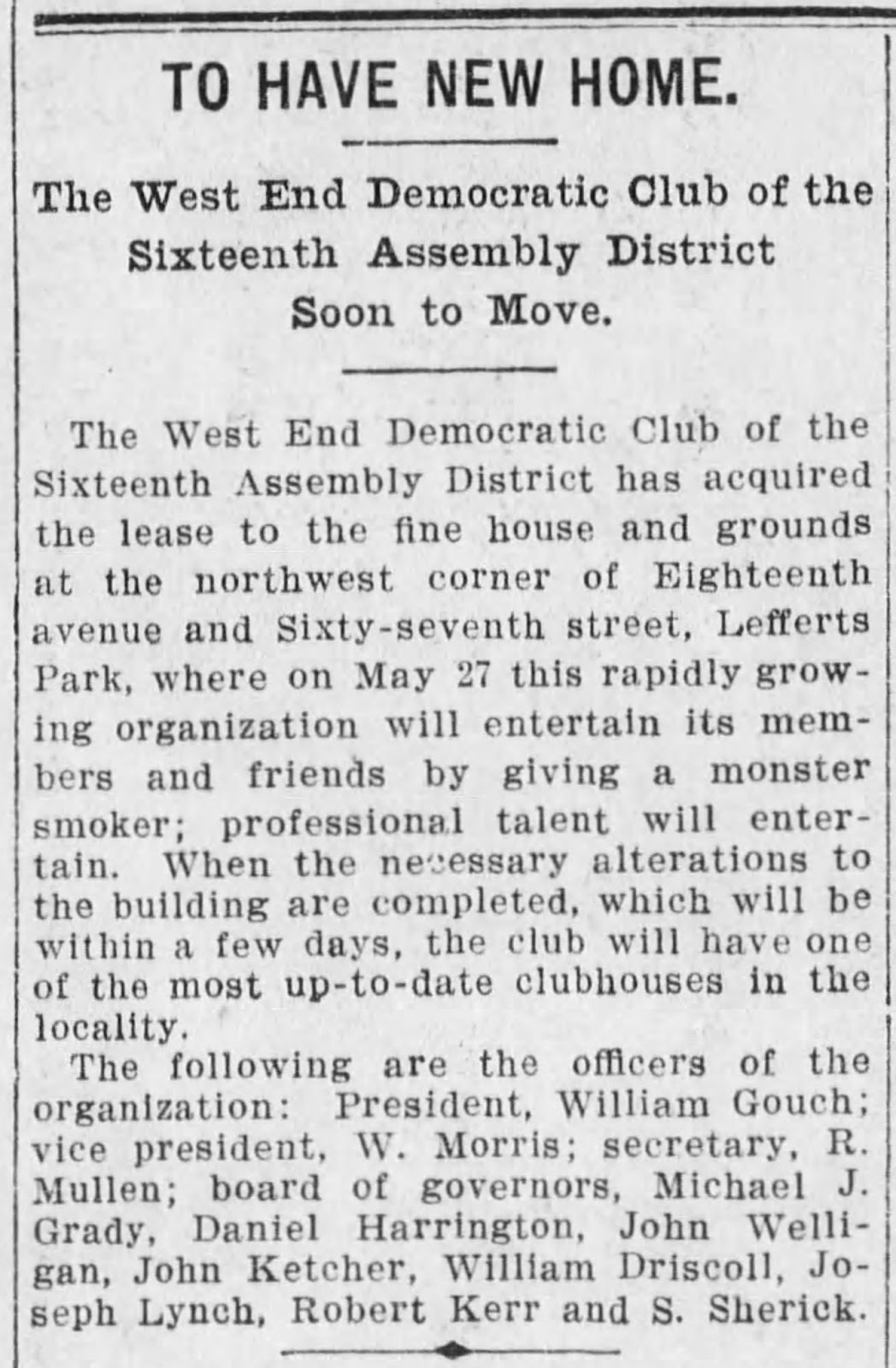
1911 May 7, Brooklyn Daily Eagle.
The announcement had one typo, there was/is no such place as "Lefferts Park"

The Daily Standard Union, in their July 2, 1905 issue published a photograph of the Van Brunt-Robert house, lamenting on the disappearance of the Old New Utrecht Homesteads. This explains the publication of Charles A. Ditmas' work, which he opens with: In these days of commercialism, we are forgetting the historic and the beautiful; the past is seldom considered until the march of progress destroys some landmark which history has made famous. Then, after the usual newspaper articles have appeared, the place is lost sight of in the possibilities of the future.

While portions of the Jane Robert Estate were being sold off one lot at a time, the Van Brunt-Robert homestead was nearing its own demise. In 1911, the West End Democratic Club obtained the lease  to the homestead and held their regular meetings and events there. The club house played a small role in the early development of the area; acting as polling place for the residents who were registered to vote or fighting for new public schools in the neighborhood. But by the end of 1916, the club moved out of the homestead to another location only few blocks away; their last recorded meeting was held on November 3, 1916.


Courtesy of Brooklyn Museum. The caption reads, "Van Brunt Robarts House previous to renovation," but no date is given. 
However, the sign on the left wall of the house reads "West End Democratic Club" 
which may indicate it was renovated sometimes before May 1911 when the club moved in.


Photograph made in 1916 by Eugene L. Armbruster, who recorded: This building was demolished in late 1916 or early 1917
After more than 150 years of existence, the Van Brunt-Robert homestead was demolished sometimes shortly after the last meeting of the West End Democratic Club in November of 1916. If there is a specific record showing additional information, or even the exact date when the house was built or demolished, I am yet to find it. Charles Andrew Ditmas, wrote in his closing sentence about the Van Brunt-Robert homestead: Should we not honor this house which silently watched and waited while history was being made, doing its duty silently and faithfully, housing its occupants unto the present day? I am only hopeful that 99 years after it has been destroyed, this blog post will serve as some token of memory of the homestead and that the new generation of owners have some appreciation of history. 


Portion of the Plate 15 of the Atlas of Kings County published by Elisha Robinson in 1890. 
The map shows locations of the buildings as well as points from where photographs were made in various years.

Portion of the Double Page Plate No. 16 issued in 1916 for the Atlas of the Borough of Brooklyn 
published by E. Belcher Hyde in 1917. Note the corner of 18th Avenue and 66th Street, the Van Brunt-Robert 
homestead was already demolished, but the Kallman Scandinavian Orphanage was still there.


Original Caption: Eighteenth Avenue, east side, at 68th Street. When 68th Street joins Eighteenth with Nineteenth Aves., this house will be demolished, as the street will run through the house. In 1857 to 1873 it was the residence of D. Robert, later it became the Kallman Orphanage. March 1925, Eugene L. Armbruster.


Prince Furniture on 18th Avenue and 68th Street, further into the block (where the third card is parked on photo) is
the approximate location of the Daniel Robert House which was built sometimes in early 1850s.
It was still standing in 1931, when the Kallman Orphanage moved to another location.

Approximate location from where the Van Brunt-Robart homestead photographs were made in 1909 and 1916;
view from 18th Avenue looking at the corner of 66th Street.
The two buildings before the Bank of America are the exact location of the homestead.
I took this photo on October 10, 2015.

Beauty Supply (6605 18th Avenue) and Smoke Stax (6607 18th Avenue)
stores are the exact sights of the Van Brunt-Robert Homestead.
I took this photo on October 10, 2015.


1924 Certificate of Occupancy issued to row of houses at 6605-6619 on 18th Avenue, Brooklyn.
Thus, by 1924, the homestead was certainly demolished.


Front view of Rutger Joosten Van Brunt House as photographed by Daniel Berry Austin on April 10, 1904
Rear side of Rutger Joosten Van Brunt House as photographed by Daniel Berry Austin, circa 1914


Notes.


*If you walk south from the N-train station on the 18th Avenue, on your right you will find the branches of the Northfield, the Citibank and the Santander banks. Diagonally from the latter is the Chase on the corner of 65th Street and on the other end of the block is the CapitalOne branch of 66th Street. Across the street is the newly risen Bank of America, and from there as you approach the 67th Street, you will encounter the Apple Bank on the left and TD Bank on the right. Then, further down the block, between the Bay Ridge Avenue and 70th Street, stands the second of the only two branches of the Cathay banks in Brooklyn. The last of this chain of banks is the Ridgewood Savings on the corner of 72nd Street. That's ten banks in a distance of eight blocks.

**Regarding the name "Van Brunt" Bergen wrote, "From whence the name is derived is involved in uncertainty, there being no place in the Netherlands named Brunt, the nearest approach being 'Bruntinge, a hamlet in the province of Drenthe, three-fourths of an hour's travel south of Westerbork, containing seven houses and fifty inhabitants.'" But there was a schoolmaster in Leyden by name of Jan Brunt in 1824 who published a book, Bergen added, and "From Jan Brunt not having the prefix of Van to his name, it may be inferred that Brunt is a proper surname, and not derived from the place from which Rutger Joesten emigrated."

†Letters of Administration dated December 19, 1722 were granted to Joost Van Brunt for his father's properties. Joost Van Brunt died sometimes in early parts of 1746, before his wife, Aeltie, who died on November 12 of the same year. Thus, the years when the house was built can be narrowed between 1713 and 1745.

††According to Teunis G. Bergen, Rutger Joesten Van Brunt, the immigrant, had 2 slaves in 1693 and 5 slaves in 1698, while his second son, Cornelis Rutgersz Van Brunt, was reported to have had 1 slave in 1693, 6 slaves in 1698, and 3 slaves in 1716, and the third son, Joost Rutgersz Van Brunt, who built the Van Brunt-Robert homestead, had 4 slaves in 1698 and 3 slaves in 1716. Bergen gave extensive details about some of the Van Brunt heirs and inventories of their estates, which included persons as part of their properties. Moreover, Marc Linder and Lawrence S. Zacharias noted that "The Dutch farmers' mentality was well represented by Judge Nicholas Cowenhoven of New Utrecht, who owned 10 slaves in 1790 and used chains in the cellar of his house 'for punishing refractory slaves.'"